

Stories
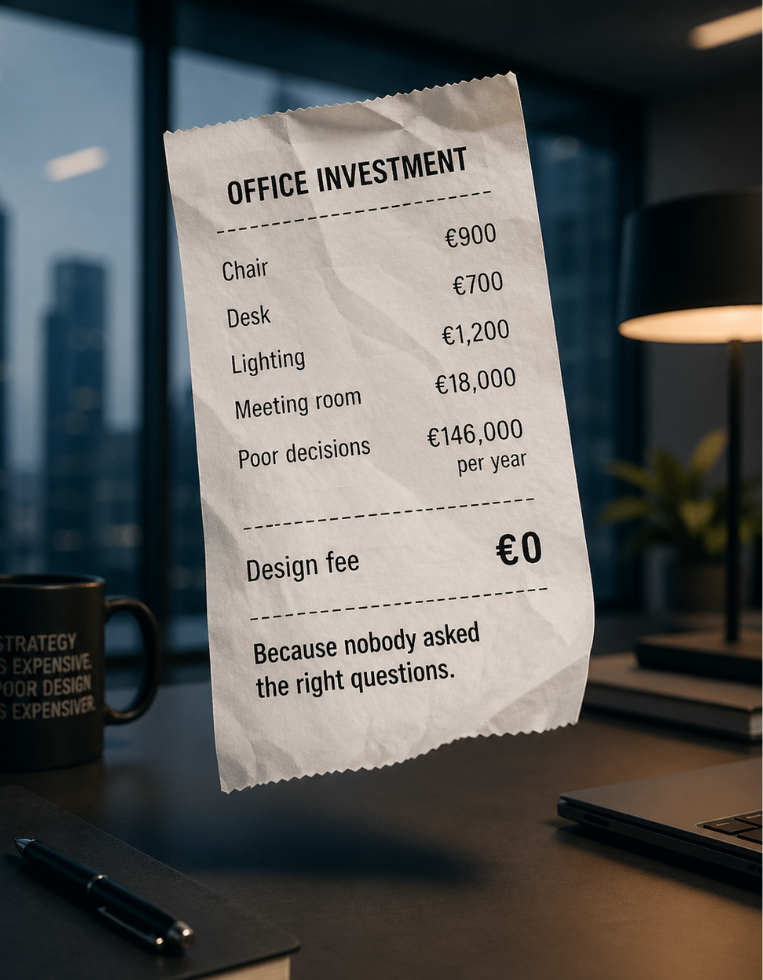
Good Design Is Free.
Not because it costs nothing. Because the returns consistently outrun the investment — and most CEOs never see this math coming
Every design conversation starts the same way. How much does it cost?
It’s a fair question. Investors, founders, and finance directors make decisions through a financial lens — budgets, payback periods, risk. That lens is not wrong. It is simply pointed at the wrong number.
“Good design is not an expense. It is a capital allocation decision that keeps paying out long after the invoice is settled.”
The value good design creates tends to exceed the money deployed into it — often by a wide margin. The returns do not sit on a balance sheet. They move through people, organizations, and culture. And they compound.
THE UNCOMFORTABLE TRUTH
Design is routinely dismissed as decoration. And the design profession shares some of the blame for this. When designers reduce their own discipline to surfaces, moods, and materials, the strategic case never reaches the client. If the designer does not understand design as a business instrument, the client never has the chance to believe in it.
Design value does not translate itself. It requires someone to frame it — as strategy, not aesthetics. As capital allocation, not embellishment. As a system that shapes behavior, productivity, and outcomes over time.
Without that framing, design stays cosmetic. With it, design becomes leverage.
A REAL RETURN CURVE
Design investments front-load uncertainty. You commit resources before results appear — which feels riskier than operational spending with visible short-term outputs. But design operates on a different return curve, and the numbers bear this out.
Stock market outperformance for design-led companies over 10 years (McKinsey Design Index)
Average revenue growth advantage over industry peers for top-quartile design performers
Higher market share held by companies with strong design cultures vs. competitors
These figures track across industries — consumer goods, technology, financial services, healthcare. The pattern holds: when design is treated as a strategic function rather than a finishing cost, it generates measurable commercial advantage.
PROOF FROM THE PRODUCT WORLD — A CASE STUDY
I saw this firsthand while leading product development at Humanscale. As lead designer, I was handed a brief to create a monitor arm system from the ground up — a complete, scalable platform, not an incremental update.
What followed was 18 to 24 months of sustained commitment. Research. Engineering. Prototyping. Tooling. Certification. A growing financial bet with no guaranteed outcome at the end of it. Every additional month was a further allocation of resources on the promise that the design thinking was sound.
HOW IT PLAYED OUT
Design awards followed. Recognition came in from the global design community — validation that the thinking had been understood, that the intent had translated. The professional ego was satisfied.
Then the sales reports started. Win after win. The competition — well-resourced, established players — had been left behind. Not gradually. Decisively. The market had voted with procurement decisions.
The culmination: the system captured 25% global market share in the monitor arm segment. And held it — year after year.
Units produced annually at peak — sustained for years
Global market share captured in the monitor arm segment
The financial case was strong. But the complete picture was richer. Every unit reduced physical strain, improved posture, and removed friction from daily work. One design decision, multiplied across millions of users, thousands of organizations, and entire careers.
This outcome was possible for one reason: the design intent was protected. The system was not compromised by short-term cost pressure. Leadership believed in the investment thesis before the results existed to prove it.
“Belief must precede proof. That is the investment posture design requires.”
NOW APPLY THE SAME LOGIC TO YOUR OFFICE
A well-designed workplace reduces physical stress, improves clarity, and enables the movement and interaction that knowledge work actually requires. These effects are not aesthetic. They are operational.
People conserve energy. Decision-making improves. Engagement rises. Employees leave at the end of the day with capacity remaining — capacity that shows up at home, in health, and in how clearly they think the following morning.
Employee turnover reduction linked to workspace quality and intentional design
Productivity gain associated with high-quality, purposefully designed work environments
ROI on every €1 invested in wellbeing-driven workplace design (Harvard Business Review)
Yet design still gets treated as a cost to minimize. Because good design works quietly. When it succeeds, it disappears into normality — people simply feel better, think more clearly, and perform at a higher level without attributing it to anything in particular. What goes unnoticed gets undervalued. And what gets undervalued gets cut.
This is the design paradox: its greatest measure of success is invisibility.
THE BROADER CONSEQUENCE
When organizations invest in environments that genuinely anticipate and respect human needs, they recalibrate expectations. People begin to expect better — of their workspace, their employer, their city. They carry those standards into future roles, future organizations, and future decisions. This is how business choices shape culture.
MY OPERATING LENS — AND WHERE IT LEADS
The monitor arm. The office chair. The workplace. Different scales, same argument. Design, executed with strategic intent and protected from short-term compromise, returns more than it costs. Reliably. Measurably.
This is my personal operating lens — the framework I apply to every project, every brief, every client conversation. Studio Novo is one of the vehicles I use to put it into practice.
At Studio Novo, we work with founders, HR leaders, and executive teams across Bulgaria and the Balkans to create workplaces where people and organizations perform at their best. Every engagement runs through our methodology:
Define → Design → Deploy: The 3D Process™
We start where most competitors don’t — with thinking. We define the human, operational, and strategic business needs before workflows and spatial layouts start taking shape. We optimize for behaviour, not appearance. And we deploy with the same rigor that a product launch demands — because measurable improvements in people’s engagement, culture, and business performance don’t happen by accident. They happen by design.
“You invest once. The returns persist. And good design becomes free.”
STUDIO NOVO · SOFIA, BULGARIA
If you are rethinking your office — or should be — let’s talk about what your space is actually costing you.
Studio Novo helps organizations across Bulgaria and the Balkans build workplaces that measurably improve people’s engagement, culture, and business performance.
Lachezar Tsvetanov
Founder and Creative Director
Studio Novo
Stories

The Brain Behind Beauty
A Design Truths Essay on Design Thinking and Workplace Design…

Beyond Back Pain: How Workplace Ergonomics Protects Your Mind and Your Team
It’s 3 PM. Your shoulders are creeping toward your ears, a dull throb settles at the base of your neck, and no amount of coffee seems to…
The Perception of Design: Where Form Meets Thought
Few people have shaped the way the world looks more than Paul Rand. For over fifty years…