

Stories
The Perception of Design: Where Form Meets Thought
The Perception of Design: Where Form Meets Thought
A Design Truths essay on why great design pairs form with thought — and what truly lasts.
Few people have shaped the way the world looks more than Paul Rand. For over fifty years he designed the identities of the companies that defined modern business — IBM, ABC, UPS, Westinghouse. When Steve Jobs left Apple in the 1980s to build NeXT, he wanted Rand, and only Rand. Rand agreed on his own terms: one hundred thousand dollars, a single solution, no alternatives. “I will solve your problem, and you will pay me,” he told Jobs. Jobs paid. He didn’t get a menu of options. He got the answer.
So when Rand argued that design, on its own, is meaningless — that its value and meaning are handed to it by the person looking — this wasn’t a cynic talking himself out of a job. It was a master describing how the thing actually works.
That doesn’t make design irrelevant. It makes it human.
But here’s the catch. Unless a designer expresses their thinking — the context, the reasoning, the evidence — what they make is open to endless misreading.
Design is no different from writing. To get a message across, you don’t toss the letters of the alphabet in the air and hope the reader reassembles them into sense. You choose your words. You arrange them with intent. You shape them into meaning.
The same is true for design.
Form Needs Thought
At its core, design is the masterful navigation of form, context, and meaning.
Without well-defined boundaries and considered intent, design can be visually beautiful and utterly hollow. The work catches the eye. Then it fails to connect.
This is why method and purpose have to travel with form. Design is not just what something looks like. It’s what it makes possible.
Design That Thinks for You, or With You
Much of the modern world is overwhelmed by overdesign. Surfaces shaped to dazzle, interfaces optimized to distract, environments choreographed to impress — but rarely to serve.
Strip away the ego and remember that good design serves the user, not the designer, and something changes.
Look at the vegetable peeler in your kitchen drawer. Around 1990, Sam Farber watched his wife Betsey wrestle with a standard metal one — arthritis had turned a cheap, everyday tool into something that hurt to hold. So he rethought it. The OXO Good Grips peeler that came out of it has a soft, oversized, ribbed handle that fits almost any hand, with or without strength left in it. It never asked to be admired. It became one of the most imitated kitchen tools in the world, and most people who reach for it have no idea why it feels right. That is the point. The thinking vanished into the form.
That’s what good design does. It makes life easier, clearer, better. Not louder. Not flashier. Better.
The Designer’s Responsibility
We, as designers, have a responsibility — to the people who use our work, to the people we work with, and to the systems we all live inside.
We must not only design things, but also design the thinking that supports them. That means decisions that clarify intent, align with how people actually behave, and improve the experience of using something or being somewhere.
This is as true of a workplace as it is of a logo. The right room, the right chair, the right fall of light decide whether a person leaves at the end of the day restored or wrung out. That is design doing its real job — not decorating a space, but shaping what happens inside it.
This is where form meets thought. Where aesthetics support utility. Where design becomes a bridge between chaos and clarity.
What Really Lasts
There is a kind of design that refuses to age.
Think of the cars Mercedes-Benz and BMW built in the early 1990s. The Mercedes W124 — the car that would go on to become the E-Class — was engineered to a standard, not down to a price. Galvanized against rust, made from parts meant to be serviced rather than thrown away, it earned the nickname “the million-mile Mercedes.” Decades later, thousands are still on the road, driving much as they did the day they left the showroom. BMW’s cars of the same era carried the same conviction: build it properly, and it will outlive the trend that produced it.
That conviction is a form of sustainability we rarely name. Not recycled packaging or carbon-neutral factories — though those matter — but the kind of quality that makes a thing worth keeping for thirty years.
I’ve written elsewhere about my own version of this — a supercharged 2004 Mini Cooper, BMW’s modern re-creation of the 1959 original. It carried my family from New York to Sofia and refuses to be replaced by anything newer. My daughters still choose it over every shinier car parked beside it. Children are the most honest design critics there are. They don’t rationalize. They just feel.
Closing Thought
Design without thought is ambiguity. Design with thought becomes language.
The best design feels inevitable — not because it’s the only way it could have looked, but because it’s the only way it could have meant something.
Lachezar Tsvetanov
Founder and Creative Director, Studio Novo
Stories

The Brain Behind Beauty
A Design Truths Essay on Design Thinking and Workplace Design…

Beyond Back Pain: How Workplace Ergonomics Protects Your Mind and Your Team
It’s 3 PM. Your shoulders are creeping toward your ears, a dull throb settles at the base of your neck, and no amount of coffee seems to…
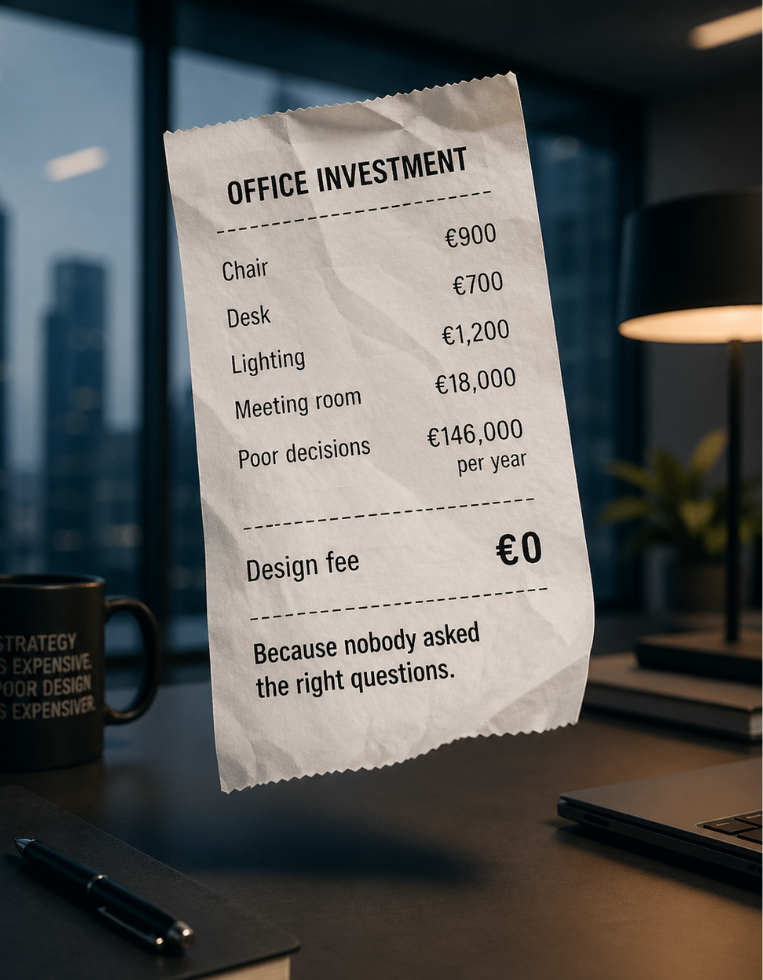
Good Design Is Free.
Not because it costs nothing. Because the returns consistently outrun the…