

Stories
The Myth of the Creative Few.
Somewhere along the way, we started believing that creativity is a privilege. Reserved for a chosen few. A myth reinforced by the world around us — from school systems that reward the right answer over the original thought, to massive companies with tiny, boxed-in creative teams.
But this belief is not only limiting — it’s wrong.
Science tells us otherwise.
Dr. Lila Chrysikou, a cognitive neuroscientist at MIT’s MaD Lab, has spent years studying how creativity actually works. Her findings are clear: creativity isn’t magic, it’s a skill. And like any skill, it can be trained.
She discovered that one of the biggest blocks to creativity is our reliance on automatic thinking — patterns and defaults we’ve learned to use because they’re efficient. When we operate in expert mode, we access those same well-traveled neural paths. That’s great for speed, but terrible for originality.
To spark creativity, Chrysikou found, we need to do the opposite. We need to disrupt those defaults. Suppress expert habits. Resist obvious answers. Look at everyday objects and tasks as if we’ve never seen them before.
That’s when imagination comes online. And when imagination kicks in, creativity follows.
This is exactly where design plays its role.
Design demands that you see what isn’t there. It asks you to question the obvious, explore alternatives, and move — even when the path is unclear. You don’t wait for certainty. You sketch. You test. You build. You adjust.
I’ve lived this process — not only in my professional work, designing products, systems, and environments — but in my personal life, too. I’ve seen how vividly imagining something, fully placing myself in that future experience, can pull me forward with surprising clarity. It’s not some abstract hope. It’s a felt reality.
Design gives us a way to channel that clarity. It takes an idea from vague to visible. From feeling to form.
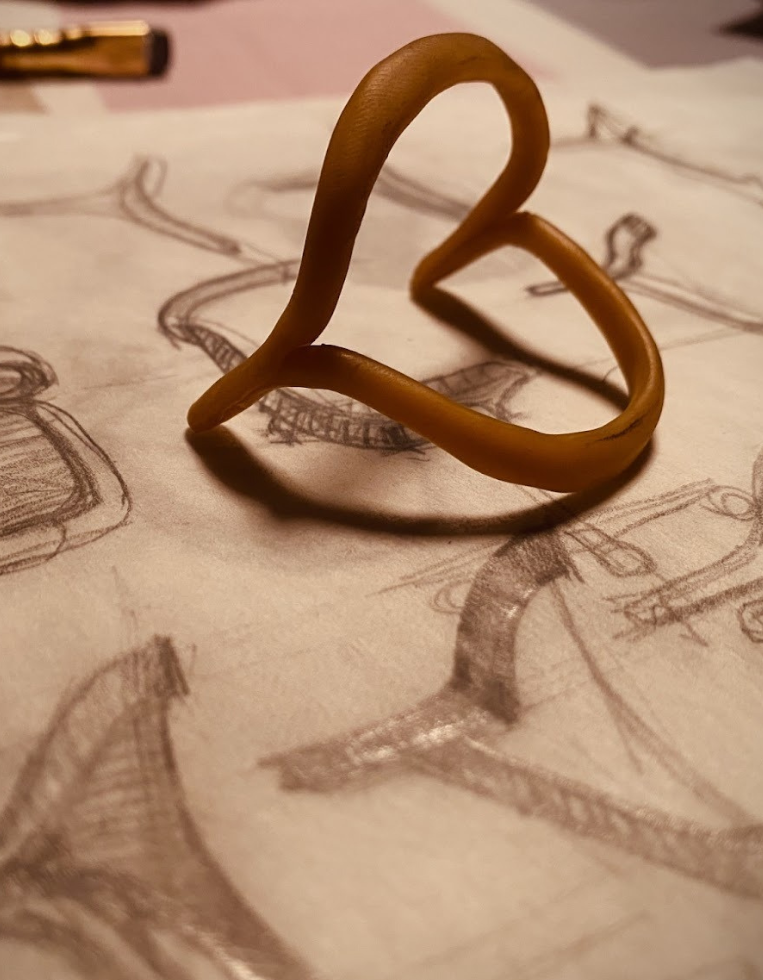
What starts as a napkin sketch becomes a prototype. What begins as a possibility becomes part of our reality.
This process is what Chrysikou describes as “recombining existing knowledge in novel ways.” We aren’t creating from nothing. We’re rearranging what we know into something better — something truer to how we want to live and work.
That’s the magic. Not talent. Not luck. Just imagination followed by disciplined action.
So if you’ve ever said “I’m not creative,” I’d argue no one gave you the right tools. Or the right mindset. Or the space to unlearn.
Because creativity isn’t rare. It’s underused.
And design — at its best — brings it back to life.
There is another perspective that deepens this idea.
One of the most underrated modern philosophers I encountered about a decade ago is Neville Goddard. I still return to his work from time to time because of one simple but powerful idea he shared.
He said: “Creation is finished.”
What he meant is not mystical. It is surprisingly practical.
We rarely create something from nothing. What we do instead is rearrange what already exists. Matter, ideas, knowledge, experience. When we reorganize these elements in a new way, the outcome can feel entirely new.
Think about steel and stainless steel. They are built from the same particles. Yet their behavior is different. Change the arrangement and the properties change. Magnetism changes. Strength changes. Resistance changes.
The same principle applies to ideas and to life.
Designers do this every day. We take known materials, known technologies, known behaviors and arrange them differently. The result can transform how people sit, work, collaborate, or live.
But this is not limited to designers.
The same process applies to our own lives. The way we arrange our habits. The environments we build around ourselves. The ideas we choose to focus on. The people we collaborate with.
Rearrangement creates new experiences.
Imagination is the tool that lets us see those new arrangements before they exist.
Design is the discipline that turns those arrangements into reality.
Let’s re-write the code on that.
Let’s practice it more often.
Lachezar Tsvetanov
Founder and Creative Director
Studio Novo
Stories

The Brain Behind Beauty
A Design Truths Essay on Design Thinking and Workplace Design…

Beyond Back Pain: How Workplace Ergonomics Protects Your Mind and Your Team
It’s 3 PM. Your shoulders are creeping toward your ears, a dull throb settles at the base of your neck, and no amount of coffee seems to…
The Perception of Design: Where Form Meets Thought
Few people have shaped the way the world looks more than Paul Rand. For over fifty years…